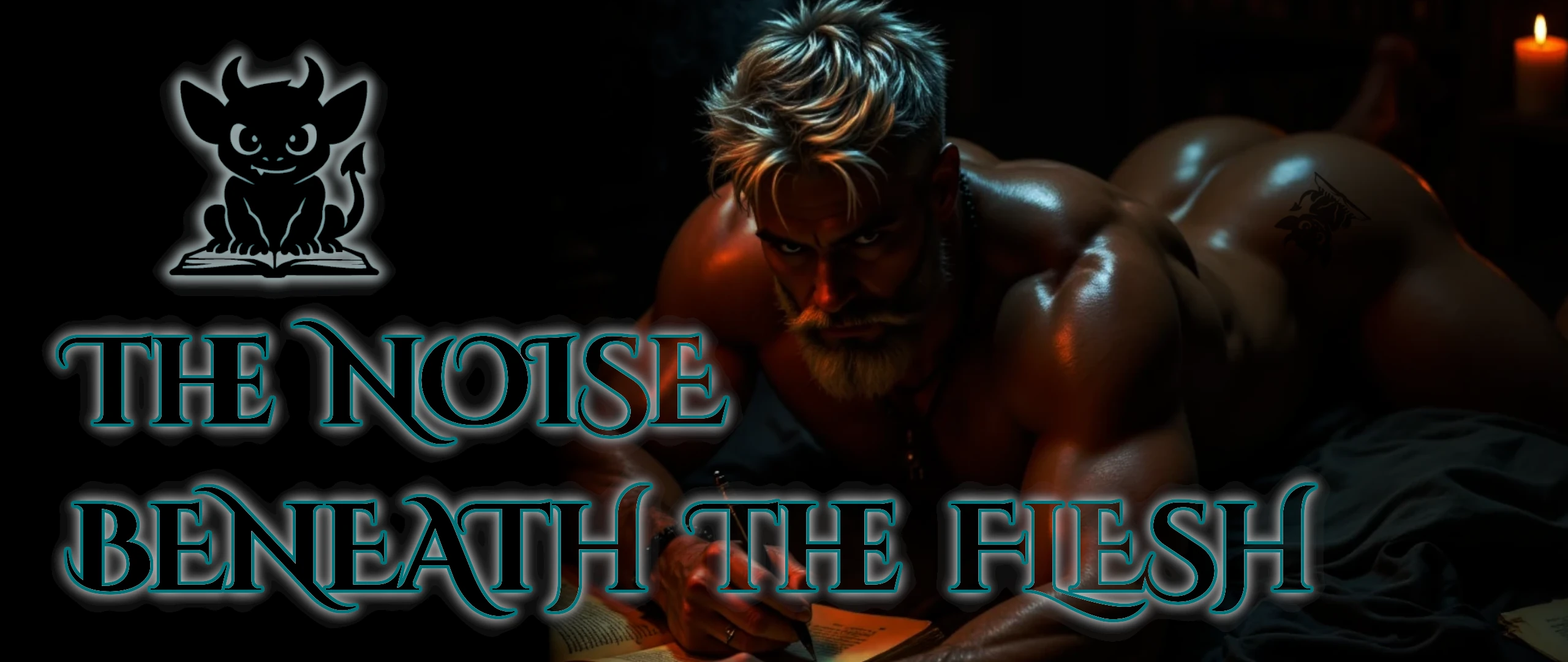
Category: Foundations · Tags: autofiction, embodiment, explicit
Calder Bare is not a pseudonym.
It’s a pressure state.
It’s what happens when the distance between author and body collapses far enough that pretending otherwise would be dishonest. Not because everything written there is “true,” but because everything written there is deliberate.
This is the part of my work that stopped averting its eyes.
Calder Bare is not autobiography.
It’s autofiction in the older sense: a constructed self that knows it’s being watched and refuses to behave politely about it.
The narrator sounds like me because it’s built from my voice.
The mistakes sound like mine because I didn’t sand them down.
The desire sounds personal because distance would be a lie.
That doesn’t make it raw in the way diaries are raw.
It makes it sharpened.
Nothing in Calder Bare is accidental.
Nothing wanders onto the page by mistake.
The myth is intentional: the man who knows better and doesn’t stop.
This wing of the work is body-forward by design.
Not symbolic bodies.
Not metaphor bodies.
Actual bodies, doing things that leave marks, raise pulse, and sometimes feel a little too close to recognition.
Voyeurism is present because being seen is part of the charge.
Shame is present because it sharpens attention.
Pleasure is present because denying it would flatten the experience into performance.
The writing doesn’t pretend neutrality.
It knows what it’s doing to you, and it keeps going.
There’s a moment readers sometimes describe as:
Wait — is this Calder?
That moment is not an accident.
Calder Bare lives in the deliberate blur between author, narrator, and constructed self. Not because I want you to wonder what’s real, but because I want you to feel what happens when certainty destabilizes.
The work doesn’t ask you to trust it.
It asks you to notice what your body is doing while you read.
That’s the contract.
Calder Bare exists because not all erotic writing benefits from restraint.
Some impulses don’t become honest until they’re allowed to overshoot.
Some desire doesn’t reveal itself until it’s watched.
Some truths don’t survive being made tasteful.
This section isn’t here to shock.
It’s here to let the work breathe at full pressure without pretending it’s safer than it is.
That’s why it’s gated.
That’s why it’s explicit.
That’s why it doesn’t apologize.
If you step into Calder Bare, you are choosing proximity.
You’re choosing:
Nothing beyond that point is coy.
Nothing is coy about being uncoy.
The work doesn’t escalate to please you.
It escalates because that’s where it was going anyway.
Calder Bare isn’t the whole of my work.
It’s one wing of it.
One heat source.
One version of the voice, turned all the way up.
You don’t need to enter it to understand the rest.
You don’t need to justify leaving.
But if you do step inside, do it the way the work asks:
On purpose.
With awareness.
And without pretending you don’t know what you’re choosing.
The red light is on for a reason.
This space is for correspondence, not performance. Messages are reviewed and won’t appear publicly by default. If you want to engage—agree or disagree—email is the right channel.